Tuesday, July 16, 2013

Comics Review: "The Sandman: Dream Country"

Even though I'm reviewing Neil Gaiman's "The Sandman" in collected volumes, it's worth noting that "The Sandman" wasn't meant to be read like this. It was originally published as single issues of comics, not as books/graphic novels, and I've been wondering lately if I'm doing the body of work a disservice by treating it like all my other book reviews instead of going issue by issue.

However, I'm going to stick with this format because "The Sandman"--and comic books in general, actually--are discussed among fans in collective terms. People speak about the Civil War story arc in Marvel Comics; or Warren Ellis's run on "Hellblazer": or Grant Morrison's multi-title "Batman" saga. Comics are published as single issues, but they're also published sequentially as multi-part story arcs. And while readers of comics historically didn't have the option of reading anything but single issues, today's comics readers rely as much  on collected editions of story arcs as they do on single issues for consumption of the material.

Digital distribution has further blurred the lines between the single issue and the collected arcs, as you have an option of purchasing one issue at a time, getting a whole arc, or even mixing and matching to create your own narrative interpretation of a work. Comixology, for example, lets you choose to read your comics by publication history, a development I'm looking forward to discussing when I get up to "Fables and Reflections."

That said, not all issues of comics are part of story arcs. In the biz, we call these "one shots." A one shot is basically meant to be viewed as short story rather than a chapter in a novel. "Dream Country" is a collection of four "Sandman" one shots, issues 17 to 20 if you're keeping track: "Calliope," "Dream of a Thousand Cats," "A Midsummer Night's Dream," and "Facade."

I was only five when these issues were hitting the racks in stores, but I can imagine how exciting it must have been to scurry on down to the local comic book shop, pick up an issue of "Sandman" and get one of these. Each of them is a gem. "Dream of a Thousand Cats" is my favorite "Sandman" story, and "A Midsummer Night's Dream" won a World Fantasy Award for short fiction in 1991 (more on that later). I don't want to say that "this is where Sandman got good," because again, it's all better than most anything else in the medium. But I do think that the stories in "Dream Country" are where "Sandman" became consistently brilliant. They hit a high note that Gaiman & Co. sustained until the very end of the series' run.

And a note about Gaiman's "& Co." I really like the edition of "Dream Country" I have because it has a table of contents that lists the different artists for each of the issues, which my editions of "Preludes and Nocturnes" and "The Doll's House" don't do. "The Sandman" became known for its wide variety of artists and styles, but sometimes it's surprisingly difficult to discern who drew which issue, especially if you have the older collected editions. I have a mix of old and new in my collection, and it's irritating to have to squint at the fine print in the copyright info to find out who drew what. Table of contents is the way to go.

Let's break it down.

"Calliope" is about writers and where they get their ideas. Richard Madoc gets his inspiration from the muse Calliope, who he keeps as a sex slave locked in his attic. Several years pass. He wins critical acclaim, audience love, money beyond his wildest dreams, all from raping and abusing the mythological goddess of epic poetry. Dream eventually shows up to rescue her, because they were once lovers and even had a son together, and also because he had just been imprisoned for several decades and knows how awful it is. When Madoc refuses to release Calliope, Dream curses him with so many different ideas for stories that Madoc goes insane. Madoc frees Calliope to make the ideas stop torturing him, leaving him a shattered, idea-less shell of a man.

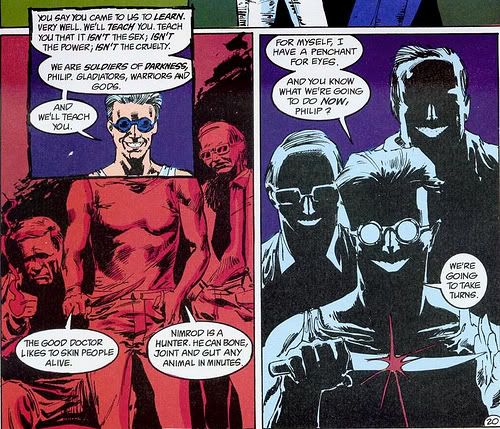
One aspect of "The Sandman" that waned as the series progressed was its horror element, and I think this story was the last one you could categorically define as "horrific." "Preludes and Nocturnes" had the visit to Hell and the diner slaughter, and "The Doll's House" had the serial killer convention. But after "Calliope," though "Sandman" was frequently scary in the psychological sense, it never really veered back into true "Hellblazer"/Clive Barker territory. And even "Calliope" resonates more for its quieter moments, like when Dream and Calliope say good-bye at the end, than for images like this:
He had no pen or paper. He wrote his ideas on a brick wall with his fingertips.
"Calliope" is a great story, and it's the first time Gaiman references Dream's son. That's going to be important later on.

What can I say about "Dream of a Thousand Cats"? I love cats. I love "The Sandman." I love that "The Sandman" did a story about cats that did for cats what "Watership Down" did for rabbits.
For death! And the world ending!
"Thousand Cats" is another frame story that features Dream as a supporting character, like "Tales from the Sand." A group of suburban housecats gather in a graveyard to hear a cat-prophet preach. The Prophet tells a story about her former life as a pampered housecat, when she was just like all of them. Her owners drown her newborn kittens in a pond because she got pregnant by a stray and the owners wanted to breed her with another purebred. She goes to the Dreaming and meets with the Cat of Dreams for guidance and advice. He tells her a story about the former Age of Cats, when cats were the size of humans and hunted little cat-sized humans in their gardens for sport.
Good times.
But the Age ended when one of the humans told the rest to dream of a world in which they were the dominant species, and one day everyone awoke to the world that we know now, where cats are just our little pets and humans rule the world. Even worse, the humans had dreamed it so that there never was an Age of Cats. They had altered reality to retcon the cat kingdom out of existence, because such is the power of a shared dream.

The Cat of Dreams tells the Prophet to spread the word among cat-kind that if they can share a dream, they can bring about the Age of Cats again. So she walks the world, telling cats to dream of a better reality, in the hope that enough of them will dream one night and they will all awake in the Golden Age again. Most of the housecats in the graveyard scoff at her story as just an entertaining bit of nonsense from a famous crazy-cat-person, but one cat in the crowd... well:
I'm crying. You can't see it, but I'm literally crying as I post this.
I love the shit out of this story. My friend R has often bemoaned the portrayal of cats in fiction, especially children's fiction, because they're almost always villains, enemies of the truly heroic animals, or sniveling, cowardly assholes ("Watership Down," "The Secret of NIMH," "Cinderella," "Homeward Bound"). This is one of the few portrayals of cats in fiction as heroes, and the fact that the Prophet is female is just icing on the cake for me.

In terms of where it fits into the "Sandman" mythos, it's a great example of what the series is getting at when it talks about the power of dreams. Dream as a character has his own set of powers, and while it's interesting to spend time with him and watch him struggle and scheme, I find "Sandman" more interesting for how Dream's existence affects those around him. This issue is the beginning of the ongoing discussion in the series: why are stories important? What do stories mean for the tellers of the tale, and for those who listen?

The discussion continues in "A Midsummer Night's Dream," which has one of my favorite conceits for a story ever: William Shakespeare and his actors put on "A Midsummer Night's Dream" for the fairies referenced in the play.
So no pressure or anything.
Will entered into an agreement with Dream, wherein Dream will give him the ability to become the greatest storyteller in the English language, and in return Will will write two plays specifically for Dream. One is "A Midsummer Night's Dream," and the other (which we don't learn until the end of the "Sandman" series) is "The Tempest."

This is the most famous issue of "The Sandman," because it won the World Fantasy Award for short fiction and was the first comic book to do so. Now, the story goes that after "Midsummer" won the award, the World Fantasy Award rules were amended so that comic books were ineligible to even be nominated in that category. I've read this on the Internet and even in some very well-regarded scholarly works (yes, scholars discuss "The Sandman," what of it?). It makes a great story because it shows how comic books are actual works of art but are still relegated to a lesser status by snobs who are out of touch with the zeitgeist.

And it's not true.

From the World Fantasy Award website:
All Fantasy is eligible, High fantasy, horror, sword & sorcery, supernatural, children's and YA books, and beyond.
Comics are eligible in the Special Award Professional category. We never made a change in the rules. 
Italicization theirs. I think they got sick of angry "Sandman" fans  bombarding them with requests to make comics eligible for regular awards again. I gather that it was like the year when "Beauty and the Beast" was nominated for an Academy Award for Best Picture. It wasn't that there was any specific rule preventing animated films from getting nominated for Best Picture, it just hadn't ever happened before.

I'm not arguing that comic books aren't still kind of pushed into this artistic ghetto and sneered at by intellectual types. That totally happens. But comics fans have got to stop repeating this story about the World Fantasy Awards changing their rules to exclude comic books in the wake of the "Midsummer" win, because it's not true, and false claims hurt the cause more than they help it.

Now I've had to spend all that time talking about the politics surrounding the story without getting to the story itself. How very meta.

So, the story--do you like Shakespeare? Because there's a lot of Shakespeare dialog in this story. I have to confess that I enjoy Shakespeare when it's being performed, but I can't seem to follow it so well on the page, and I tend to gloss over the parts of this story that are the actors performing "Midsummer." However, what I do really enjoy in this play is the relationship between Will and his son, Hamnet, who's been feeling rather neglected since his father made a pact with the immortal anthropomorphic manifestation of dreams. Hamnet is traveling with Will and the theater troupe so that father and son can become closer, but all Will cares about is his stories. Hamnet even jokes with one of the players that if he died, his father would just make a play out of it.

That's on one side of the curtain. On the other side, the audience side, the fairies and Dream enjoy the night's entertainment. Some common fairies in the back row provide a bit of comic relief, as one of them can't follow the story and thinks Dream just brought the troupe there to be the fairies' dinner. Robin Goodfellow, called the Puck, is so excited by the play that he puts the human player to sleep and takes his place on stage. King Auberon gives a sack of gold coins to the head actor, which of course turn into dead leaves when the sun rises because fairies are assholes. And Queen Titania gives an apple to Hamnet while telling him how great life is in her kingdom, an interaction Will ignores because he's too busy watching his own play.

If you know a bit more than the average person about the life and works of Shakespeare, you may get a chill watching Hamnet and Titania together. In the play "Midsummer," one of the early plot points is that Titania adopts a human child. Hamnet plays this part in the comic's version of "Midsummer." And in real life, William Shakespeare did have a son named Hamnet who tragically died when he was just eleven years old. The implication in Gaiman's "Midsummer" is that Hamnet was stolen by the fairies, because again, fairies are assholes.

One more significant development in "Midsummer." Dream has a rather one-sided conversation with Titania, who was maybe his lover at one point (implied rather than stated). He's having doubts about the pact he made with Will, a crisis on conscience in the wake of gifting the man with stories. Dream made the pact because he wanted the old stories to live on through the ages, which is a high priority from Dream's perspective--he has a job to do as the Prince of Stories and he's going to do it to the best of his abilities. But he didn't tell Will what such a gift would cost him and Will didn't bother to ask, which is pretty typical of mortals. Not just because mortals are short-sighted, but because (as Dream fears) they wouldn't understand the costs even if they were told. Their minds aren't meant to comprehend someone like Dream.

It's a rare moment when Dream ponders his impact on people's lives and suddenly doubts that what he does is right and fair. Dream isn't usually a character who looks to the past or thinks very deeply about the decisions he makes. He's been doing this job for a long time. He knows what he's doing, thank you very much, and he will not be criticized by those who think they know better just because a couple of mortals get trampled along the way.

This is going to come back around in a big way in the next volume, "Season of Mists." Get ready.

Okay, I've spent a decent amount of time talking about the most famous (and perhaps best) issue of "Sandman." I have more to say, but there's one last story in "Dream Country" to get through, so let's move on to "Façade."

Dream isn't in this story at all. It's about a day in the life of Urania Blackwell, also known as Element Girl, a DC comics C-list superhero who now lives as a miserable shut-in because she's too ashamed to show her hideously misshapen face and body to the world. All she wants to do is die, but she's basically indestructible and can't think of any method of death that would actually destroy her.

So Dream's sister Death comes by and gives her a bit of good advice, leading to possibly the only happy ending in fiction caused by the main character's successful suicide.

It's weird to read this story right after "Midsummer." "Midsummer" is so grand and weighty, stuffed full of important historical and mythological personalities. "Façade," by contrast, is a much slower, more intimate story about an insignificant nobody dying alone in a filthy studio apartment. But I feel the two stories are thematically connected and actually flow quite well together.

First, they are both about immortality. Will enters into a pact with Dream so that his stories may live forever; and Urania enters into a pact with Ra, the Egyptian sun god, so that she too can live forever. Neither Will nor Urania understand the true costs of their pacts at first, but one of the immediate consequences in alienation. They are no longer ordinary mortals, they are special. Will becomes distant from his family in order to focus on his work, and Urania cuts herself off from the world entirely.

(An aside: I'm not familiar with the character of Element Girl in the regular DC comics, so I don't know why she isn't out there fighting crime like a regular superhero. It isn't explained in this story, and I have to assume that she just didn't have the temperament for it, as she seems like a gentle soul who maybe cracked under the pressures of crime-fighting, but that's pure speculation on my part.)

Another way these stories are connected is that both are about loss. Dream commissions "Midsummer" from Will because the fairies aren't going to visit Earth anymore, and Dream doesn't want their contributions to the world to be lost or forgotten. One consequence of this is that Will loses his son twice over, once because he neglects the boy to write the play, and then again when Hamnet dies/is taken by the fairies. When Urania becomes Element Girl, she loses her humanity and any hope for a normal life, and most of her story is her dealing with that loss.

However, what makes "Façade" special is that Urania's story has Death in it instead of Dream, both in the literal and metaphorical sense. Dream as an entity is all about stories, and Urania's story has ended. Nothing happens to her and nothing ever will, so she's beyond Dream's notice and influence. The only left for her is the end. She needs to meet her death, and Death. 

Death, when she comes, tells Urania that in the end, all things die, and Death is there to meet all of them at the end. Again, this is in contrast to Dream, who is rather discriminating about those he meets directly, and very choosy about who gets his special attention. But whether you're a mortal, a god, or a galaxy, Death is there for you. But not in an ominous way, like "there's no where to hide"; more like "you don't have to go through this alone." Death holds Urania when she cries, comforts her about her miserable wreck of a life, and mediates between Ra and Urania so the former can release the latter from her immortal existence. She's quite friendly, this Death, and just wants you to get where you're going. 

It's quite a feat of narrative to end a story with a suicide and still leave the reader feeling uplifted. You don't hear about "Façade" very much in "Sandman" fandom (I imagine it comes up more among fans of the Death spin-off series), but it's as good and profound as anything else we'll see moving forward.

Final Grade: A. It's the shortest of the "Sandman" volumes, but "Dream Country" is a winner all the way around.

Next time: volume 4, "Season of Mists." We return to Hell.

Saturday, July 6, 2013

Quick Hit: "Breakfast of Champions" by Kurt Vonnegut

At this point in the summer, it should be time for another "Sandman" review, but I'm out of town this weekend--as I was last weekend because I'm very popular and important--and there isn't time.

I'm going to do a very quick review of Kurt Vonnegut's "Breakfast of Champions," which I read in a single sitting on the Fourth of July, Independence Day, America's birthday, the best of all days etc.


This is the second Vonnegut book I've reviewed. The other one was "Slaughterhouse-Five" if you want to relive the magic. I thought it would be appropriate to read Vonnegut on Independence Day because he always has such cutting things to say about American society, and "Breakfast of Champions" is no different.

This is the first work of his I've read that deals explicitly with racism, and I was pleased to discover that he does it right, for lack of a better term. Not to be down on the genre, but scifi writers, especially male ones, tend to hold some troubling views about sex, gender, and racial politics ("John Carter of Mars"). It always bums me out to read something racist or sexist in a book I've been enjoying up to that point, because I'm not a person who can sweep aside the more problematic elements of a work and enjoy the rest of it at face value. Once the author has revealed himself as racist or sexist, the work loses credibility in my eyes.

But we're not talking about those authors, we're talking about Vonnegut, who I feel to be the greatest American satirist since Mark Twain. His books are basically, "This is bullshit, and this is bullshit, and this thing here that you've never thought that deeply about, it's bullshit too, and fuck the wealthy and the awful people with too much money and power, and fuck you for putting up with it, you poor doomed bastards."

But, you know--literary.

"Breakfast of Champions" is the least scifi book of his that I've read. There are no aliens, time travel, post-apocalyptic scenarios, or crazy inventions. A wealthy man in a Midwestern town is going mad; an aging and unsuccessful scifi author is hitchhiking to the Midwestern town to attend an arts festival there; they briefly collide; and eventually the scifi author is going to win the Nobel Prize in medicine for his theories on ideas as viruses.

There's also a few subplots about writers as the Creators of small universes, since the narrator of the story is the writer of the story. It gets a little meta in places, for example when the author explains that he gave this character's mother these traits because the writer's own mother had them, and it scarred the writer in the same way that it scarred the character. And yet, even though the book tells you several times that this is all made up and even pulls back the curtain to show you how its crafted, the story never stops feeling meaningful. It's an amazing thing that I don't feel I've described very well here. You just have to read it yourself and experience the genius that is Vonnegut.

Final grade: B. I always enjoy Vonnegut, but this isn't one of his stronger works. Recommended for fans of the author and those who like biting social commentary. Happy Independence Day!

Wednesday, July 3, 2013

Comics Review: "The Sandman: The Doll's House"

Here is the growing pains story arc of Neil Gaiman's award-winning, critically-acclaimed "The Sandman" comics series.

Personally, I think this is the weakest volume of the bunch. "The Doll's House" has a lot of cool ideas and some genuinely good single issues within the larger arc, but overall, it's a bit of a mess. It suffers from some truly bad dialog, lack of cohesion to its central theme, unclear explanations of its larger mysteries, and honestly, the worst coloring I've ever seen in a mainstream comic. I wondered if it was just my copy, but J, who you'll remember is reading this series with me, said that her copy has terrible coloring, too. Maybe it's just the re-prints and the original issues looked okay, but man alive, in some places it looks like a four-year-old took some frayed felt markers to the artwork.
The awfulness of that dye job haunts me.
I'm going to get tired of saying this, but this volume is still good, because it's still "The Sandman," which is better than most anything produced in the medium. But there are 10 books in the series and someone's got to be the bottom of the heap, so I'm going to call "The Doll's House" the worst of the bunch and dive right in.

"The Doll's House" is an immediate sequel to "Preludes and Nocturnes." Dream has returned to the Dreaming with his tools and sets himself to the task of repairing the damage done while he was imprisoned. Four major citizens of the Dreaming are missing and running loose in the real world, and a phenom known as the Dream Vortex has manifested itself in the young American, Rose Walker (she of the awful colored hair). Dream has to locate and subdue the missing dreams and deal with the Vortex before the dreams do any more damage in the real world and the Vortex destroys the Dreaming. In the meantime, lurking in the background is the second of Dream's siblings we've met: Desire, a being of indeterminate sex who lives in a giant scale replica of itself.
It's a house--and a doll! Symbolism!
Desire has a hand in Dream's current troubles, although we don't know the extent of its involvement until the very end of the story. And this is my major problem with "The Doll's House." I have no clue what actually happens in the story. Individual plot points are fairly easy to suss out, but I don't get the larger significance behind those plot points and what repercussions they have in the "Sandman" universe as a whole.

The volume opens with a single-shot issue called "Tales in the Sand," which explains how Dream came to have a girlfriend he condemned to suffer forever in Hell (we met her in the previous volume). Bad breakup, basically. Desire admits that it had a hand in all that pilikia, because Desire is an asshole and likes to fuck with Dream for shits and giggles. So Desire has a hand in Dream's present troubles, too, though damned if I can figure out what it is.

I get what Desire did, and even why it did the thing (I'm trying to avoid giving spoilers for a 20 year old comic). What I don't understand is how Desire knew that doing the thing would result in a Vortex. Dream says to Rose Walker that he doesn't understand how or why a Vortex happens. If Dream himself doesn't understand Vortexes, how does Desire know? Dream is the elder sibling and Vortexes happen in his realm, clearly he's the expert on them, yet Desire understands them better and is even able to predict when and how one will appear?
And seriously, what is up with her hair?
This bugged the shit out of me when I was 13 and it bugs the shit out of me now. A lot of heavy metaphysical stuff happens in "The Sandman," and fortunately Gaiman got much better at explaining the larger ideas and how they fit into the rules of the "Sandman" universe. But this first time around, he sets up some interesting concepts and can't quite stick the landing. There's a little too much left un-explained for both the readers and for the characters in the story, and that bugs me. If I don't get it, fine, but if the characters don't get it either and don't know what lesson to take from it, I'm left wondering what the point is. Considering that Rose Walker reappears throughout the series and is clearly "important," there should have been a better explanation of why she matters and what impact her existence has on Dream.

I'm being awfully hard on a comic that's still better than anything I've ever written. Let's talk about what works in this volume. The issue "Collectors," much like "24 Hours" in "Preludes and Nocturnes," is a wonderfully horrific little story about a serial killer convention. I loved it as a morbid 13-year-old, but I love it even more now, because I've been to comics conventions and I get all of the con in-jokes Gaiman makes.
Also, it's creepy as fuck.
There are two one-shots included in this volume that are as good as anything else in the "Sandman" series. I already mentioned "Tales from the Sand," which is significant because it's the first time we get to see what will become a regular occurrence in the series: the frame story, or the story within a story. These frame-story issues usually have an ordinary person telling a story in which Dream is a side character. If we're going by the hero's journey as set by Joseph Campbell, then Dream appears at the point in the story when the hero ventures to the underworld (the Dreaming) to get advice from the spirits/gods (Dream).

As early as "Imperfect Hosts," the third issue of "Preludes and Nocturnes," Dream is called the Prince of Stories. And as Gaiman expanded this universe, he expanded the meaning of "dreams" to include all stories, storytelling, and storytellers. The Dreaming became not just a place where people go when they fall asleep, but the metaphorical and literal birthplace of all stories, and the best issues of "The Sandman" are inevitably the ones that really explore what stories mean to people and what they mean to Dream. The next volume, "Dream Country," is made up entirely of these frame stories, so I'll discuss this more next time. But "The Doll's House" did it first with "Tales in the Sand" and is therefore notable (and redeemable) for it.

The second single-shot issue in this volume is "Men of Good Fortune," which has nothing to do with the events of "The Doll's House" but is delightful because it introduces Dream's one and only friend: Hob Gadling.  Hob was just a dude in a tavern in the twelfth century, drunkenly bragging to his buddies that death is optional and he never intends to die, so Dream gives Hob immortality.

They meet in the same tavern once every 100 years to have a drink and talk about what Hob's been up to. Sometimes Hob is doing great--has a knighthood, a family, lots of wealth--and sometimes he's alone, destitute and being drowned as a witch by neighbors who notice he doesn't age. At their meeting in the nineteenth century, Hob tells Dream that they only reason Dream keeps meeting him century after century is that Dream is lonely and wants a friend. Dream gets all huffy that the implication that a being of his power and stature would deign to be friends with a mortal, or even have the need for something so base as friendship. However, their meeting in the twentieth century happens shortly after Dream has been imprisoned naked in a glass box for 70 years, which tends to clarify a person's priorities, so he shows up for his meeting with Hob because they're friends!

This is one of my favorite issues of "The Sandman." It's so sweet and optimistic, unlike most of the other stuff in the series, and it shows Dream in the best possible light, as someone capable of forming bonds of trust. "Men of Good Fortune" gets to the heart of why friendship is so important to people's development and growth. Most of the time, Dream does what he does from a sense of duty and barely-concealed sanctimony (which is why he can't hold on to a girlfriend). This is the only time he does something because he wants to, and he's a better, more decent individual for it.

Hob continues to pop up every now and again in the series, and it's always a little heartbreaking when it happens because it illustrates the gulf between Dream and his dreamers. All living things, humans, animals, gods, planets and stars pass through his realm, but he is only friends with one person in the whole of existence. It's a tragedy in the true sense of the word, because it's a situation of his own making, and it will eventually prove his undoing.

Grades: C+ for the main story arc in "The Doll's House." The coloring is distractingly bad, I don't think Gaiman knew many Americans at the time because the American characters' dialog is clunky and forced, and there's so much left unexplained that I can't rate it higher than "Preludes." But the serial killer convention is awesome.

However! Grades of A for the two one-shots, "Tales in the Sand" and "Men of Good Fortune." This is the sort of thing that people talk about when they talk about "The Sandman."

Next time: "Dream Country."

Thursday, June 20, 2013

Comics Review: "The Sandman: Preludes and Nocturnes"

About a month ago, I walked into the comic book store and recognized the person J checking bags at the door. It was a glorious moment, and not just because I was coming from seeing "Iron Man Three" and it was free comic book day.

J used to worked on my floor in a now-defunct department, which meant that in addition to her job at the comic book store, she was in need of another work study gig at the school. And we had just lost a round of work study employees to graduation.

Worlds were colliding.

J gives me the opportunity to bring my hobbies into the office. I gave my coworkers fair warning that she was coming and that her presence would reveal depths to my nerdery I've only hinted at before. Though how could any warning ever really prepare the uninitiated for listening to a two-hour conversation about "Star Trek: Deep Space Nine"? (Survey of office-mates indicates it can't.)

Anyway, J and I are re-reading Neil Gaiman's groundbreaking "Sandman" comics together this summer. Reading with others opens you to fresh perspectives on familiar works, and since summer is the time when a lot of my geek websites run fresh reviews of old/classic television shows, I'm going to take this opportunity to review the first comic books series I ever read.

"The Sandman" was published by DC's Vertigo imprint from 1989 to 1996. Its seventy-five issues were collected into ten volumes, which I will now type from memory (you'll have to trust me that I can do this trick, as there's no way to confirm that I didn't just open a wiki-page on another tab): "Preludes and Nocturnes," "The Doll's House," "Dream Country," "Season of Mists," "A Game of You," "Brief Lives," "Fables and Reflections," "Worlds' End," "The Kindly Ones," and "The Wake."

I think I got all the apostrophes right, but some of those "and"s may be ampersands.

As I said, this was the first comic series I ever read. I'd always loved the comic strips that ran in newspapers, especially back when "Calvin & Hobbes" and "The Far Side" was still being published and the funnies page was worth a damn. Everyone knew to set the funnies aside for Rachel to read with the intensity of  a medieval scholar deciphering an illuminated manuscript. I rarely laughed (except at "Garfield," fat cats are hilarious). The jokes didn't interest me as much as the interaction between words and pictures, how they could tell a story over time and suggest movement and speech where there were only static images on newsprint.

I was primed to make the leap from the funnies to comic books, but unfortunately, it was the 90s, which was kind of a nadir in the mainstream comics industry.

It didn't help that the only comic book store I ever encountered was Android's Dungeon on "The Simpsons," and that establishment wasn't exactly a bastion of culture and good life choices.

Without holding a single issue of a comic book in my hands, I knew that it was shameful to like comic books. When I went to the library to check out a "Garfield" or "Calvin & Hobbes" collection--always with a couple of real novels, like a teenager trying to disguise a pack of condoms with Slim Jims, paper towels and discount Halloween candy at the drug store--I'd see the "Batman"s, "X-Men"s and "Avengers" collections. I'd see them. I'd want them. But I didn't touch them, not even to flip through. Not because they were "for boys," though I know that turns a lot of little girls away from comic books. I didn't pick them up because comics were stupid trash for stupid people. They were low class entertainment, and I was too smart to waste my time on them.

Like a lot of nerds, smart was all I had. I wasn't good a sports, I wasn't popular, and I wasn't pretty, but damn, was I smart. And like a popular girl whose life can come crashing down around her if she gets a bad haircut, I wouldn't be caught dead with some "picture book" in my hands. Every book I read, I wanted people to see me reading it and be impressed by how advanced my reading tastes were. I didn't even read the Harry Potter series when it came out even though it was written for people my age, because I read adult novels, not kid-stuff. (Yes, I was also kind of insufferable. Who isn't at 13?)

I had a friend who was just as insufferable as me, if not more so because she was also kind of goth-y. And she loved "The Sandman," as is the goth's wont. She uttered the gateway words that have seduced many a pseudo-intellectual down the dank and musty aisles of the poorly-ventilated comic book store:

"It's not a comic book. It's a graphic novel."

Graphic novel I could handle. It had the word "novel" right there in the title, which meant it was literature. It helped that the cover of "Preludes and Nocturnes" is one of artist Dave McKean's fabulously surreal constructions of wood, flowers and madness, with not a pair of tights or a cape in sight. You don't question the intelligence of a girl reading a book like this.
"If you have to ask what it means, you don't get it."
McKean did most of the covers for "Sandman" (though he didn't do the interior artwork), and he did them in the pre-Photoshop era, which meant he literally constructed them. This is a photograph of a sculpture that actually stands about four feet high, as I learned the first time I saw Neil Gaiman speak.
I bring this up because even though I was a pseudo-intellectual who had to justify my love of the comics medium by couching it as this alternative art form that you had to be sophisticated to understand, the people who created "Sandman" actually were intellectuals. They were groundbreaking alternative artists pouring their hearts and souls into this massive, sprawling epic that strove to do nothing less than illuminate the nature of imagination itself.

Not that you can tell from "Preludes and Nocturnes," which collects issues 1 to 8 and covers the first story arc of the life and times of the titular Sandman, the King of Dreams, also called Morpheus. Re-reading it as an adult, I'm struck by how simple it is, and how unlike it is from the volumes that follow. It's not a bad story--in fact I think the strength of the series is that even when it's not at the top of its game, it's still better than almost anything else in the comics medium--but its clearly going through some growing pains, switching artists after its third issue and relying on some rather clunky voiceover narration from Dream to keep the story going.

Later in its run, "Sandman" would become known for its rotating cast of stellar artists putting their own spin on a character whose appearance changes depending on whose looking. Its hard to criticize the shift in style that comes half-way through this volume when it foreshadowed such good things to come. And the voiceover disappears altogether after issue 10 or 11, meaning that as clunky as it feels as a storytelling device, "Preludes and Nocturnes" is also the closest the reader ever gets to being inside the head of Dream, who actually becomes more distant and unknowable the longer the series goes on. For that reason, it's fascinating to see him narrate his quest, even if it doesn't always work as a storytelling device.

So what happens in this story arc? The King of Dreams is captured by an English magician in 1916 and spends the next seventy years trapped in a glass dome in the magician's basement. Various characters, some of whom we'll meet again, develop sleep disorders resulting from Dream's imprisonment and the subsequent metaphysical distortions through the fabric of Dreamtime. Then Dream escapes and spends the rest of the story trying to recover three lost magical objects that give him most of his power: a pouch of sand, a helmet made from the skull of a god, and a ruby.

As my friend R says, it's basically a video game. Each object he re-acquires levels him up and gives him the power he needs to move on to the next item on the list. He finds the pouch of sand with the help of John Constantine, a character who enjoyed an extremely successful run in the "Hellblazer" series, to which the early "Sandman" owes a great artistic debt.

(Lecture alert! Alan Moore created the character of Constantine for his groundbreaking series "Swamp Thing," which was one of the earliest mainstream comics to publish without the seal of approval from the Comics Code Authority. While the 90s were a pretty awful time for superhero comics, the 80s and early 90s saw the arrival of several British writers and artists who revolutionized the medium and are largely responsible for making comics good again. See Moore's "Watchmen," Grant Morrison's "Animal Man," and of course, Gaiman's "Sandman.")

After the pouch, Dream goes to Hell to recover his helmet from a demon. This was probably the issue that really got me hooked on "Sandman," and remains the point in the volume at which I really become interested in the story. The artwork is superb, and it's the first time the reader gets to know Dream as a character in his own right, not as a shadowy figure humans encounter in the darkness. More than any other issue in the story arc, it also sets up characters and plot points that are part of the larger "Sandman" epic. Dream meets an ex-girlfriend in Hell, is a righteous dick about it, throws his weight around with the Lords of Hell while trying to conceal his lack of power over them, and David Bowie Lucifer vows to destroy him. All of this will come back to bite him in the ass.

I'm less wild about the next chapter, where Dream meets some members of the Justice League  and discovers that a D-list supervillain has his ruby. But the issue after that is about the supervillain spending 24 hours in a small-town diner, driving its patrons mad with the power of the ruby. The reader is trapped within the narrow walls of the diner with the victims, but is also aware, through the TV in the background, that the whole world is succumbing to the same madness. Excepting the violent imagery, this issue could be an episode of the "Twilight Zone," which frequently took place in small-town diners in apocalyptic settings. Dream only shows up on the last page of this story, after everyone has tortured, murdered, fucked each others' corpses, and committed suicide.

"24 Hours" somehow manages to be more horrifying than the issue set in actual Hell. It also set up some of the major themes that run through "The Sandman": the power of self-contained worlds; the existential horror of the Hells we carry around inside of us; and the idea that what we see, however grand or terrifying it seems to our eyes, is just a small facet or a representation of a much larger whole. Gaiman states in the afterward that he didn't feel he found his voice until the last issue of this volume, "The Sound of Her Wings," but for me, the whole thing really starts coming together and feeling like "The Sandman" (in italics with a note of hushed awe) in "24 Hours." In a lesser series, this issue would have been a highlight, but in "The Sandman," it feels more like we've finally reached the status quo and are ready to rock.

The next issue, "Sound and Fury," is okay. It's appropriately climactic. Supervillain and King of Dreams battle for possession of the ruby, laying waste to the Dreaming realm while the world continues to cut, burn, and slaughter itself. The artwork is good and there's enough gravitas to really sell the idea that if Dream loses, all is lost. But it reads more like the penultimate issue of a standard superhero story arc than the type of story "Sandman" would become. When I was younger, I loved it. Now, I tend to shrug, because I know that this isn't the best they can do.

I understand what Gaiman meant about finding his own voice. Most of these early issues are heavily indebted to other comic series, with cameos and references from all corners of DC in order to firmly establish "The Sandman" within that universe. And while they're good--often great--"The Sandman" ultimately ends up going in a very different direction, far away from DC universe continuity and deep into its own mythology. It becomes bigger and grander, pulling away from adventures and quests and addressing more the existential quandaries implied by the existence of Dream and the rest of his family, the Endless.

In "The Sound of Her Wings," we meet his sister Death.

Possibly no other character in this series has had as much impact on pop-culture as Death, not even Dream. She's just a sweet, perky goth girl who happens to be the anthropomorphic manifestation of the darkness at the end of all things. And even though she's super busy, what with all the people dying all the time, she wants to cheer up her little brother, who's kind of been a whiny jerk since he escaped from that glass box and saved the world. I love the relationship between Death and Dream, who may be these powerful cosmic beings but are also, underneath it all, a brother and a sister from a dysfunctional family who have no one but each other to lean on when times get tough.

There is a truthful emotional core to this issue that's somewhat lacking in the rest of "Preludes and Nocturnes." It's a quiet moment of family bonding to round off a parade of horrors and strife. As "Sandman" progressed, it succeeded whenever it hewed to this formula (and tended to fail when it didn't, as we'll see next time in "The Doll's House").

So that's "Preludes and Nocturnes," volume one of the critically-acclaimed "Sandman" comics series. Does it hold up under the scrutiny of the adult reader who doesn't care if her co-workers see her reading Harry Potter in the lunch room? Absolutely. It's not the strongest story arc of the series, but it's also not the weakest. It's very different from the series "The Sandman" eventually becomes, but it's also similar enough that I can appreciate the differences as an interesting evolution and progression of ideas and themes. I still find things to like about it, and not as many things to dislike as I expected.

Final Grade: B. It can't be higher because it is a little clunky and rough around the edges, but it also can't be lower because it's the fucking "Sandman" and it's still better than anything the rest of us chuckle-heads will ever come up with.

Next time: "The Doll's House."

Wednesday, June 12, 2013

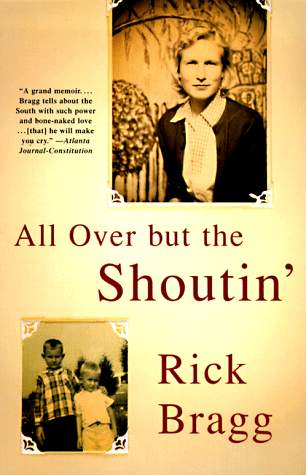
Review: "All Over But the Shoutin" by Rick Bragg

It's been a while since I reviewed a memoir.

There was a time when I was really into this genre and read all the memoirs I could get my hands on. I even wanted to write a memoir myself, but had to put that project on hold because--I don't know if you know this--memoirs are really, really hard! You'd think at first glance that they would be easier to write than fiction because you're drawing from real life events, and the writers who do it well make it look effortless. However, a memoir has a very difficult task to accomplish: take something that is, by definition, complicated and without end (LIFE) (let's pop some bold and underline on that actually) (LIFE) and transform it into a neat, linear story with a beginning, middle and end.

Life is very unsuited to literature. It defies the standard three-act structure, never supplies the satisfying story and character arcs that make for compelling fiction, and has this nasty way of just petering out into the next series of events without giving you any satisfying conclusion. There are no bangs at the end so you know when to clap.
Maybe if they'd shot him out of a cannon at the end?
As proof of my theory, today's author, Rick Bragg, had to win a Pulitzer in journalism before he wrote his memoir, "All Over But the Shoutin." Or maybe that's just a coincidence. Either way, it's quite a good memoir about growing up poor in the rural South.

This describes a lot of offerings in the memoir genre, I know, and Bragg admits at the beginning of his book that his is a very typical story and perhaps of no interest to anyone. He didn't write his memoir to break new ground, but rather because his beloved grandmother died and made him aware of how little time certain members of his family may have left on the earth. He wanted to capture their stories and life experiences before they died, because they'd always been dismissed as unimportant in the eyes of society, but were important to him personally and therefore worthy of memorializing.

I don't think this is best memoir I've ever read, but I found it noteworthy because of how self-effacing Bragg is in describing his life. Memoir writing is inherently a narcissistic endeavor, in that the author assumes that whatever happened in her life is so fascinating that the rest of the world needs to know about it. Frequently the author is correct in that assumption, otherwise why would we read memoirs? But Bragg's memoir is significant because he focuses less on what makes him and his family unique, and more on what makes them the same as all the other people he meets later in life as a journalist, even if those other people are freedom fighters in Haiti or bodega owners in the Bronx.

There's a wonderful universality about Bragg's writing that you don't often encounter in the memoir genre. The book does suffer in  a few places from having a too much emotional distance from its main subject--Rick Bragg--but makes up for it by imbuing even passing characters with liveliness and humanity.

Final Grade: B. Recommended for fans of memoirs, stories about the South, and those interested in journalism.

Saturday, June 1, 2013

Review: "The Tender Bar" by J.R. Moehringer

Holy shit, did I never post this?! I wrote this review weeks ago and it's just been sitting in my drafts box

So this was not a memoir about alcoholism, let me get that out of the way. When a book is about a childhood and early adult hood spent in a bar, you expect it to be about substance abuse (also, the description on the cover said it was the best book of its kind since Mary Karr's "The Liar's Club," which was about alcoholism).

But "The Tender Bar" is actually about masculinity and how a boy learns to be a man. The author, J.R. Moehringer, was raised by a single mother and had to cobble together father figures from the men at his local Manhasset, Long Island bar, Publicans. The various uncles and neighbors and friends who showed him how to be a good man--and in many cases, how not to be a bad man--are vividly portrayed with both humor and pathos. I didn't learn anything about the masculine identity I didn't already know (as a woman, I already know far too much about the male ego, what makes it tick, and what makes it dangerous, as I discussed in my review of "Wide Sargasso Sea"), but it was a nice change of pace from the kinds of books that I usually read, and a reminder that white males who go to Yale are humans, too.

The star of this work isn't the narrator, though, or the men he gathers around himself to emulate. Publicans is the true subject of "The Tender Bar." The book is as much a history of the bar and the honored place it held in the community as it is about J.R. Moehringer, and I really enjoyed that aspect of the story. The bar, as an active character in the book, was the beating heart of Manhasset, a real public house where everyone, men, women, and children, could go and be welcomed with food, drink, and company. Publicans provided a safe place for the author during the rough times in his life, and also provided a compass for the decisions he had to make as he stumbled toward adulthood, and it's heavily implied that he was only one of many who needed the bar in this way.

Continuing my theme of books that didn't go where I thought they would, the fact that this book wasn't about alcoholism says a lot about how I expect drinking narratives to go. I don't know if it's my latent Temperance Society woman coming out (I'm not going to say my latent Puritan, because they drank like fish), but I do feel weirdly guilty that I expected the author to turn into a wretched drunk who had to reject the bar in order to get sober and live a truly meaningful life. The life he led in Publicans was deeply meaningful, and overall the relationship he had with the bar was a healthy one. This is a rare memoir about a drinking life that isn't about substance abuse.

And he ends the book by realizing that all of the things that make a good man were right in front of him the whole time, embodied in his mother, so take that, patriarchy!

Final Grade: B. Recommended for fans of memoirs, stories about boys and their fathers, and the people you meet in bars.


Book Review: "The Rabbi's Cat"

So it turns out that art schools have a pretty good selection of comics and graphic novels in their libraries. Today I'm reviewing "The Rabbi's Cat," an original graphic novel from French writer and artist Joann Sfar.

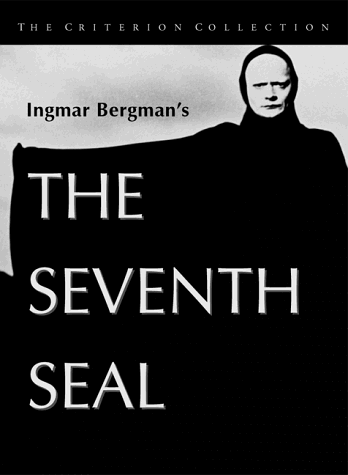
"The Rabbi's Cat" was also made into a well-received animated movie that I haven't had a chance to see yet. Maybe the BF will let me put it on the Netflix queue--and maybe he'll finally return "The Seventh Seal" so we can start getting other DVDs in the mail again.
You have had this since February and haven't watched it. Admit defeat and return it so we can get more cartoons.
The story is told from the point of view of a cat owned by a prominent rabbi in 1920s French-colonized Algeria. Kitty is just an ordinary kitty until he eats the rabbi's parrot, at which point he becomes sentient and gains the ability to talk. To the consternation of his owner, the first thing Kitty says is a lie: "I didn't eat the parrot." So the rabbi tries to turn Kitty into a pious, Jewish kitty by teaching him the Talmud, even though Kitty wants to skip all that and go straight to learning the Kabbalah.

This is a story about the Jewish experience, much like "To the Heart of the Storm" by Will Eisner. "The Rabbi's Cat" isn't actually about the rabbi's cat--it's about the rabbi and the people he has to teach and guide in his community, even when he isn't entirely sure where he's going himself. His world is in a constant state of change: modernization of clothing, morals and attitudes among his congregation; changes in French bureaucracy that could remove him from his post; his daughter is getting married to a Parisian Jew from an entirely secular family; and his cat has learned how to argue scripture with him.

It's tricky to incorporate anthropomorphic animals into a story without it becoming childish or overly precious, and I think Sfar did a great job of making Kitty into a fully realized, adult(ish) character without losing the humor and whimsy that cats bring to the lives of their owners. Furthermore, Sfar seems to have a very specific reason for telling the story through the eyes of the cat instead of via one of the human characters. He uses the the outsider perspective of the animal narrator, who neither understands nor conforms to societal pressures and expectations, to great effect to illuminate the various states of separateness and alienation experienced by Algerian Jews both in their homeland and in the land of their colonial overlords. As a free agent, Kitty can observe and question human behavior in a way that the rabbi, who is bound by all the myriad rules of the Torah, has never done before.

Also--kitties!
Joann Sfar with cat. *squee*

Final grade: B. Recommended for fans of cats and those interested in the Jewish experience and life under French colonial rule.