Showing posts with label feminism. Show all posts

Sunday, December 8, 2013

Scifi Review: The Left Hand of Darkness

The sixties. Hell of a decade for science fiction. Kurt Vonnegut's "Cat's Cradle" and "Slaughterhouse-Five," Robert Heinlein's "Stranger in a Strange Land," Philip K. Dick's "Do Androids Dream of Electrical Sheep," aka "Bladerunner," and "The Man in the High Castle," aka "The Nazis Won."

But like everything that ever existed, it's not all about white dudes. This week we're going to look at Ursula K. Le Guin's 1969 novel, "The Left Hand of Darkness," which broke new ground for the exploration of feminism in science fiction. The book raised the bar for the sci-fi genre in general, reaffirming its importance in the family of literature as a vehicle for challenging deeply held societal concepts.

"Left Hand" takes the concepts of sex and gender--which are so fundamental to the identity of humans everywhere that they seem to fall under the category of "instinct" rather than "cultural norm"--and asks what would happen if they simply didn't exist. What would humans be like without genders or sexual identities?

I feel compelled to point out that this isn't like the Junior Anti-Sex League in "1984," nor is it the weee, free love let everyone fuck everyone else! in "Brave New World." Sci-fi abounds with societies in which sexual behavior is distorted or controlled by governments and outside influences--that's pretty much the world we live in now, which is why so many authors of all genres like to write about it.

Nor is it like that one episode of "Star Trek: The Next Generation" where the writers tried to make a point about gay rights by having an alien from ambi-sexual, genderless race "come out" as female and declare her love for Riker, only to be kidnapped by her family and go through gender conversion therapy to get rid of all the lady in her.
To be fair, who wouldn't turn lady for that face?
The examples above start with the assumption that humans have genders and sexual identities, and extrapolate situations in which those attributes are shaped or controlled to achieve various societal and cultural outcomes. "Left Hand" is significant because it begins with a different premise altogether. It asks readers to imagine a world in which humans don't think about those things because they simply don't exist. What if we really could just treat each other like "people"?

The world of "Left Hand" is populated by humans who are gender neutral the vast majority of the time. Once a month, they go into "heat," as it were, wherein their bodies are able to get pregnant or sire children. For those few days, their bodies have a "gender" or a "sex" as we might conceive it, but because people have an equal chance of being either gender every time they go into heat, such distinctions are largely meaningless. Except for those few days of the month, the humans have neither the urge nor the ability to have sex, so while the society has "room for sex, it is a room apart."

Ironically, I have to spend a lot of time talking about sex in order to introduce a society in which sex simply doesn't matter. Except for a few pages toward the beginning, describing what I've outlined above, the plot of "Left Hand" isn't at all concerned with sex, gender, or sexual identity. The most significant aspect of this book, the one everyone talks about when they talk about "The Left Hand of Darkness," is the least important part of the actual story, which is about a small planet's first contact with alien life. But that's how central sex is to our own society--it's there even when it's not.

So, the story is about first contact. A human from our Earth, Genly Ai, has come to the icy planet of Gethen as an envoy for this vague, benevolent organization of planets called the Ekumen (the United Nations or Star Fleet equivalent of this world). He is there to convince the people of Gethen that they are not alone in the universe and invite them to join the other planets in trade and cross-cultural exchange. One high-ranking member of the government, Estraven, believes in Genly's mission and what he represents, but Estraven is outmaneuvered by another politician, who wants to use Genly's presence to start a war with another country. Estraven and Genly both end up exiled to the other country, which is a totalitarian state. They have to escape from a concentration camp and get out of the country over a glacier in the middle of winter, with the slim hope of contacting Genly's ship and crewmates in orbit around the planet if they reach civilization alive.

I remember being somewhat perplexed the first time I read this book, because I thought it was going to be explicitly about sex and power, a la "The Handmaid's Tale." It's actually an adventure story, full of political intrigue, daring escapes, and treacherous journeys through merciless but beautiful landscapes. Gethen is in the middle of an ice age, so the characters are always on the razor edge of survival, and tiny decisions can mean the difference between life and death from exposure or starvation. (It's winter here in New York, by the way, and I hate it, which is why I decided to read this book.)

I read in a couple of different reviews that "Left Hand" is considered soft science fiction, meaning it's more concerned with characters and society than with physics or engineering. And it's true that while the narrator Genly Ai is an alien from a society that has mastered space travel, Gethen itself has about the same technology as the era in which it was written, minus television and air travel. However, I find it more challenging than other hard sci-fi works I've encountered, such as Isaac Asimov's "Foundations," because reading "Left Hand" requires a constant readjustment of the reader's relationship to the Gethen characters.
I had to view them as both male and female, and remind myself that their actions and attitudes have to be seen as coming from both sexual identities. It's quite a mind trip. I can't accurately describe how it makes me feel as a reader to work so hard at undoing my social conditioning about sex and gender, just to understand a character and a world that has neither. That, for me, is the very definition of "speculative fiction." And it is hard.

No pun intended.

Final Grade: B+. Lots to like in this book, and it's challenging without being boring. But it's essentially a buddy story, so people who go into it expecting to see advances in technology or sweeping societal changes may be put off by the intimate nature of the plot.

Wednesday, September 4, 2013

Comics Review: "The Sandman: A Game of You"

Summer doesn't end until the autumn equinox, so technically there's still time to finish my Sandman retrospective. There's still time!

As always, SPOILERS abound!

The thing about "The Sandman" is that you start reading it and you think, "Wow, this is amazing." And then you go on reading it and think, "No, that wasn't amazing, this is amazing, I didn't know what amazing was when I said that first bit was amazing." And then, "What was I thinking?! I could beat my Past Self with a stout rod, THIS is the true meaning of amazing."

Then you get to "A Game of You" and it's like the word "amazing" has crawled off the page, spanked you in a firm but loving manner, given you head, and made you lasagna and a martini.

I feel a little bad about grading "The Doll's House" so harshly now. The events in it were clearly important because the series keeps circling back to them, first in "Season of Mists" and now in "A Game of You." It makes me look at "The Doll's House" a little differently, knowing that it was where the series got off the ground in terms of the long narrative. I still think "The Doll's House" is the weakest of the bunch, but I find I don't mind as much that Dream Vortex was so poorly explained, or that the main character was so flat and uninteresting compared to the side characters.

This week's outing, volume 5 of "The Sandman," takes one of those side characters and explores in depth what the Vortex did to her life, both sleeping and waking. In "The Doll's House," Barbie was happily if creepily married to a man named Ken, and in her dreams, she was Princess Barbara, ruler-goddess of a fantasy land under siege by a mysterious evil force known as the Cuckoo. Barbie's encounter with the Vortex leaves her with neither brand-name approved husband nor princess fantasy world. She's divorced, living in a crappy studio apartment in New York, and entirely unable to dream. Her absence has left her fantasy land and its inhabitants without a princess and at the mercy of the Cuckoo.

"A Game of You" opens with some of these inhabitants discussing Princess Barbie's long absence. Her closest companion, a large dog-like creature named Martin Tenbones, decides to go to the real world to find her again. He uses a dream-stone, the Porpentine ( a close relative, as it were, of Dream's ruby dream-stone from "Preludes and Nocturnes) to leave the Dreaming and come to Manhattan, but is quickly cut down by the NYPD. With his dying breath, he passes the Porpentine off to his beloved princess and begs her to save the land from the Cuckoo and destruction.

This is one of the story arcs in which Dream himself doesn't appear much. When Martin Tenbones passes from the Dreaming to the waking world, Dream coldly observes that Barbie's fantasy land, a distant dream-island known as a "skerry," is dying and that he won't do anything about it. That's what skerries do, they live and they die, and this is a story about one's death.

That sounds depressing. And it is. "A Game of You" is the saddest story in the "Sandman" universe. I'd even place it higher in tear-jerk factor than "Brief Lives" and "The Kindly Ones," because at least those stories concern sad events that matter in grand scheme of the universe. "A Game of You" is a tragedy that takes place on the margins of the everything, and its characters are rejects from mainstream society whose lives (and deaths) only matter to a very few other insignificant people. Unlike "A Doll's House," in which our main character is very special and immensely powerful, but just doesn't know it yet, "A Game of You" is about people who will never be special and realize over the course of the story just how un-special they really are.

It's dark stuff.

And it is phenomenal.

"A Game of You" is arguably the best "The Sandman" has to offer. It's not my personal favorite, but objectively, this is the best piece of literature in the bunch. It's meticulously plotted and paced, it's characters live and breathe from their very first panels, and it illuminates better than a lot of other storylines what the Dreaming is, who goes there, and why.

The power of the Porpentine enables--or forces--Barbie to return to her dream-land, but Martin Tenbones wasn't the only person who knew how to find her. An agent of the Cuckoo, a man with a chest full of crows named George (the man is named George, not the crows), has been living upstairs from Barbie in New York and monitoring her. When he sees that she has the Porpentine, he cuts open his chest and sends the crows out to menace the neighbors, giving them horrible nightmares in the hopes that they will destroy the Porpentine in order to stop the bad dreams.

I said a couple of review back that "The Sandman" veered away from horror after "Calliope," but I think I spoke too soon. The nightmares the crows give Barbie's neighbors and friends are some of the creepiest images in the series. Barbie's best friend Wanda is kidnapped by comic books characters and threatened with saws and scalpels in a Bizarro-universe hospital; neighbor Foxglove is menaced by her old girlfriend Judy, who we last saw stabbing her own eyes out in the diner slaughter sequence from "Preludes and Nocturnes";  Foxglove's current girlfriend Hazel, who fears she may be pregnant from a drunken one-night stand with a gay man, dreams of a corpse-baby who comes to life to eat her; and neighbor Thessaly--well, she makes her dream-crow burst into flames by looking at it, and then she goes upstairs to murder George with a bread knife.

One of these people is not like the other.

Because I'm a writer and not an artist, I tend not to talk much about the artwork in "The Sandman," but I want to pause here and take a moment to acknowledge the art of "A Game of You." Shawn McManus drew all but one of the issues, and his style is strikingly different from the other "Sandman" artists up to this point. One the one hand, it's a little more cartoony than say, Mike Dringenberg, who did a lot of the early issues and "Season of Mists," but it has this amazing clarity to it that you don't often get even these days in mainstream comics.

You can really see it in the faces of the characters. In superhero comics, often the only way to tell people apart is their hair and costume; the faces and bodies all look the same, especially the female characters, which may as well be traced from a Hustler magazine for all the variety the artists give them. But in "A Game of You," the faces not only look different, they look distinctive. In the last issue, Barbie meets Wanda's family and you can actually tell that they're all related. This may not seem like that great a feat, but as someone who reads a lot of comic books, I can tell you that it is unusual and rare to see related characters actually look like each other without all looking the same.

As long as I'm talking about art, I have to retract my earlier comment that "The Doll's House" has the worst coloring ever, and shift that comment over to the inking in "Sandman" issue 34, chapter 3 of "A Game of You." Colleen Doran took over for McManus for this issue, and if you look at her original pages, they're great. But George Pratt came along to ink the pages and it came out looking like shit. The artwork was so bad that when DC released the Absolute Sandman editions, issue 34 was replaced with  Doran's original artwork that she re-inked herself.
Good art.
I don't own that edition, so  I'm stuck with the version that both Doran and Gaiman hated.
Shitty art. The more you know.

There's your comics industry gossip for the day! Back to the story.

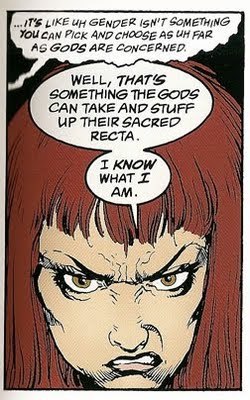
Thessaly is an immortal witch who tears George's face off his dead body, nails it to the wall of his apartment, and makes him reveal all he knows about the Cuckoo. She decides to go into Barbie's dream and kill the Cuckoo, not because Barbie may die if she doesn't, but because you don't get to be an immortal by letting people push you around. To get to the Dreaming, Thessaly pulls the moon down from the sky and forces it to let her, Foxglove and Hazel take the moon's road into Barbie's dream. The three of them get to go because they fulfill the maiden-mother-crone archetype. But Wanda has to stay behind in New York with the comatose Barbie and the face nailed to wall because only women can walk the moon's road and Wanda was born a man.

Imagine, if you will, being a thirteen-year-old girl. (Pick your own, though, don't imagine being me, I was me, nobody else gets to be.) Imagine being thirteen in a small, fairly religious community with rigid ideas about gender and a streak of anti-intellectualism. In other words, imagine being thirteen in the United States of America. And you're reading a book in which all the main characters are women, two are gay, one is transgendered, one is a witch, and they're all trying to defeat a creature who exploits the angst little girls feel as they mature and become aware of the limitations imposed on them by society simply because they are female. 

In feminist circles, this is known as the "click" moment, when sexism ceases to be an abstract concept and is recognized as something that affects you as an individual. The political becomes personal.

I'm not gay, or transgendered, or particularly witch-like, although I did go through a goth phase after reading "The Sandman." It's a bad look for the tropics, Google "sweaty goths" and you'll see what I mean. But this was the first media representation of gay and transgendered people I encountered that treated them as individuals, with lives and stories that were just as important as that of our White Male Protagonist, Dream.

This was also the first time I realized why it's so important for people to see themselves reflected in the stories they consume, not in an abstract analyze-this-piece-for-symbolism way, but in an explicit this-is-the-point-of-the-story way. All of "The Sandman" is about the importance of stories: the stories we tell others, the stories we tell ourselves, and the stories we live without being aware that we are doing so. "A Game of You" in particular is about the stories that sustain us, sometimes for years, but must nevertheless come to an end. Who are we, both with and without these stories? How do the stories we tell about ourselves create our identities? And how can we learn to move on when we can't move back?

We're still only about half-way through the story. This shit is dense. 

Thessaly, Foxglove and Hazel are walking the moon's road; Wanda watches over Barbie's body in New York and chats with George's dead face; and in the dream-land, Barbie has been betrayed by one of her friends and is captured by the Cuckoo. The Cuckoo, as it turns out, takes the form of a ten-year-old Barbie and rules the land from Barbie's childhood home. She takes Barbie on a tour of the house and weaves a spell with her voice, explaining who she is, who Barbie is, and by the way Barbie and the land need to die now if that's all right with her.

The Cuckoo was able to take up residence in Barbie's dreams because of Barbie's deep need for escape from the boredom of her waking life. Her parents wanted her to be a "little lady" and discouraged her from reading superhero comics or playing with boys, so she created a dream based on fantasy books and populated it with living versions of her toys. She became a princess, which is pretty much the only fantasy little girls are allowed to have, and in this fantasy, the Cuckoo was both her mortal enemy but also an integral part of the story. When Barbie lost her dreams due to Rose Walker's Vortexing, the Cuckoo was unable to fly away and go to lay Cuckoo eggs in the minds of other imaginative little girls, and now the only thing that will free her is the destruction of the skerry, which was once her cradle but is now her prison.

So Barbie destroys her dream.
Dream helps. A little.
The ending of "A Game of You" is a huge bummer, I'm not going to lie. Everyone one of Barbie's beloved dream-toy-friends dies, her fantasy land dies, and the Cuckoo flies away unscathed. The women on the moon's road show up too late to stop any of it, so not only was their journey in vain, but when Thessaly drew down the moon to get them to Barbie, the brief absence of the moon in the sky caused a hurricane in New York City (which is eerily prescient, I have to say). Dream shows up and offers Barbie a single wish, which she uses to get herself and the other women back home to New York, but when they get there, the hurricane has completely destroyed their building and everything in it.

And Wanda is dead.

The last issue of this story arc is Barbie attending Wanda's funeral in Kansas. She's homeless, broke from spending the last of her cash on a bus ticket to the funeral, and Wanda's family doesn't even want her there. She sits on the edge of Wanda's grave for a while, talking to her about the secret world's that must exist inside of everyone, and as she leaves, she uses a tube of lipstick to write "WANDA" on the headstone over her friend's (male) birth name. The story ends with Barbie at the bus stop after the funeral, remembering a dream she had of Wanda and Death smiling and waving good-bye to her.

I cried the first time I read it. I cried this time. This is a story that makes you have deep, complex feelings, and makes you think hard about big, scary things. It never stops being incredibly sad and beautiful at the same time, how a person can be irrevocably altered on the inside and yet remain the same on the outside; how people struggle to make their insides match their outsides, so other people will look at a person and see the true self instead of the self that came with birth and other un-asked-for circumstances; how people leave and die for reasons no one can understand, because the beings in charge of those kinds of things are kind of assholes and don't like to think about the terror and anguish us mere mortals live in because of them. (Seriously, Thessaly, way to be a fucking asshole about the whole thing.)

I think that's why I consider "A Game of You" to be the best of the bunch: because it takes these huge, frightening concepts and arranges them in such a way that not only do you have to look at them, but you want to look at them. Most of us don't want to think about how we've changed or how we will change as we get closer to death. Most of us don't like to think about death. But "A Game of You" asks you to look at those things, not because the story wants you to be uncomfortable, but because it wants you to be comfortable. It wants to show you that they aren't such bad things to think about, that this whole being alive thing is not as scary as it seems, though that doesn't mean it doesn't matter. It matters deeply, and that's why you need to look at it.

I don't know, it's a little hard to describe. I'm pretty sure you could read the book yourself in the time it's taken you to read this long-ass review, and I've left out so much! I've left out all the references to "The Wizard of Oz," and what it means for both the kind of story Gaiman is writing AND the significance that story has within the gay community. I didn't touch on the controversy of Wanda's death and how some feel it perpetuates the "Bury the Gays" trope, which I feel is a valid criticism even if I don't necessarily agree with it.

But again, long-ass review. Read it yourself.

Final Grade: A+.

Sunday, December 16, 2012

Review: "This Is How You Lose Her" by Junot Diaz

Another late review of another very recent book, Junot Diaz's "This Is How You Lose Her" (2012). At this rate I'm going to be putting together a Best Books of 2012 list! (I'm not actually going to make that. I read books to escape from the endless chasing of trends and fads, not to wallow in it. Books enable us to slow down and ponder; trying to read everything in the zeitgeist defeats the purpose, in my opinion.)

Diaz won the Pulitzer back in 2007 for "The Brief Wondrous Life of Oscar Wao," which I also read and thoroughly enjoyed. I learned a great deal about the history of the Dominican Republic, specifically about the reign of the dictator Rafael Trujillo, who ruled the island nation with blood and terror from 1930 to 1961. And I especially liked "Oscar Wao" because Diaz relied heavily on fantasy and science fiction analogies to explain the complex politics and history of Trujillo's Santo Domingo.

"Lose Her" is a much more intimate novel. Written as a series of interconnected short stories, the book centers around the narrator Yunior, who can't stop screwing around on his girlfriend Magda. She leaves him and he just can't seem to get over it, even though he was the one who kept a truly shocking number of sucias on the side.

"Sucia" and the masculine "sucio," as near as I can tell, means "slut." With Google Translate, it would be extremely easy for me to look up the exact meanings behind all of the Spanish words and phrases scattered throughout Diaz's prose--in fact, others who've read Diaz tell me they get frustrated because they keep stopping to look up definitions--but I don't bother. One, because context usually provides clues to meaning, and two, because I know the teensiest bit of Spanish and can figure most phrases out if I give it a moment's thought. I don't often try, though. Diaz hits that sweet spot of just enough Spanish words, but not too many of them, making prose that is both readable and slightly mysterious. We can peek through the windows into these characters' world, but can't just walk in through the front door whenever we please.

Another thing I like about the Spanish-English prose is that it really gives the impression of Diaz writing for an audience of Dominican Americans. I'm always slightly bothered by authors who go to foreign countries and write about the people in those countries, because those authors aren't writing for those people; they're writing for other (white) people at home to better understand the "foreigners." That's why Isabella Bird's "The Hawaiian Archipelago" didn't get an A on my rating system and why Leslie Marmon Silko's "Ceremony" did.

Ah, hell, I didn't review "The Hawaiian Archipelago" yet? I so clearly remember building that post in my mind. Is it possible I just thought about it so hard that I completely forgot to actually write it? This is my real problem with having a book blog: I read too much. Every time Saturday rolls around, I've got about three books I've finished that week that I can review, so I pick one and tell myself I'll review the others the next time around--by which time I've finished three more books! I'm going to have to write more reviews. Or read less books, I guess.

Where was I? Right, Junot Diaz's "This Is How You Lose Her" reads like a book written by and for an audience of Dominican Americans, and I very much enjoy that kind of writing. There's a whole sub-genre of Pidgin literature in Hawaii that seeks to legitimize the language and culture of local residents descended from the East Asian and Pacific Rim immigrants of the late nineteenth and early twentieth centuries. I took a class on Pidgin Lit in college and learned a lot about how language shapes cultural and individual identity.

For example, if Diaz had used the English word "slut" instead of "sucio" or "sucia," the true meaning of the term would have been lost. "Slut" has all sorts of cultural and moral baggage attached to it, but it's the baggage of the English-speaking society from which it originates. "Sucio" has an entirely different meaning and significance for the Spanish-speaking society that uses it. Swapping "sucio" for "slut" doesn't work because each society has different attitudes toward sex and morality. For one thing, "slut" applies only to women and has no male equivalent, whereas "sucio/sucia" is both masculine and feminine depending on the suffix and can apply to either gender. That right there says a lot about the different ways sexuality is expressed and viewed in the English- and Spanish-speaking cultures that Diaz explores in his work.

This brings us back to the plot of the book. Yunior is muy sucio, as was his father, his brother, and all of his friends. They all have clandestine sex and sometimes even children outside of their primary relationships, and they measure the strength of their masculinity by the number of women they fuck. How the women feel about this behavior doesn't matter to them, because they figure they can always find another woman if one leaves them in disgust. Yunior finds the flaw in this logic when the woman who leaves him is the one woman he desperately wants to keep, and no girlfriend he finds afterwards can replace her.

I see some similarities between Yunior and Madame Bovary, who also slept around on her partner out of ill-defined boredom and a desire to make her life fit the pattern of some archetypal romantic heroine. However, Madame Bovary models her sexual life on the trashy romance novels she reads. Yunior models his behavior on his real-life family and peers, which makes his situation almost more hopeless than hers because he has the tacit encouragement and approval of everyone around him to keep acting like a cheating piece of shit, even when it costs him everything. 

"This Is How You Lose Her" isn't a very happy book, but it is a realistic one that thoroughly explores the damaged psyche of a man who lost a good woman because of his society's poisonous attitudes toward sex and relationships. We can file this one away under the "sexism hurts men, too" umbrella. Patriarchy--it's a bitch.

Final Grade: B. Recommended for those who like a tragic love story, seeing a cheater get what's coming to him, or exploring the dark side of sexism from the perspective of someone who benefits from it.

Saturday, October 20, 2012

"The Happiness Project" by Gretchen Rubin

I don't normally read non-fiction outside of my comic books.
This happened. And then they hushed it up!
But I was in LAX after my sister's wedding, killing time before my LA to New York City flight by browsing the airport bookstore because all bookstores are a siren call to me even if they're showcasing "Girl with the Dragon Tattoo" and "50 Shades of Gray" (Grey? I have too much personal integrity to look it up). Airport bookstores always stock books of the zeitguiest, so I was unexpectedly exposed to a whole new set of reading material I would never seek out for myself. "The Happiness Project," by Gretchen Rubin, was one of those books. Since it was my inspiration for re-starting this blog, it feels fitting to dedicate my re-inaugeral post of Big Island Rachel's Books to a review of "The Happiness Project."

Did I like it? Yes. Am I incorporating some of it's material into my life? Absolutely. But was it perfect? Of course not. I had some major problems with the way the author presented her project, and it will surprise no one that the things I found most problematic were--wait for it--gender roles.

So "The Happiness Project" is one person's attempt to optimize her happiness. I like this sort of thing. It's lifehacking, shortcuts to making things easy for yourself, and as I said, I found a lot of stuff in the book useful. Rubin did tones of research into what happiness is and what makes people happy from a scientific standpoint. This wasn't a touchy-feely spiritual book (though there was a chapter on spirituality), it was a fact-based attempt to be the happiest person the author could be in the circumstances she was currently in.

Some things I took away: if you ACT happy, you will FEEL happy. No more walking around with slumped shoulders and a sour look on my face, no more "I'm too tired" to smile at my customers. Do things you're passionate about. You get more energy from doing something you love than you do from sitting around doing nothing, even though you think the sitting-around time is what's going to energize you because hey, what's more energizing than resting? On a related note, there's more happiness in "project happiness" than there is in "instant happiness." Hence the increase in my blogging and the decrease in my cartoon watching. I'm going to get more happiness from updating my regular blog, my books blog, and my Tumblr--and of course the radio show--than I am from re-watching "Sherlock" (which I'm actually doing while I type this, because shut up, it's a good show).

So those are the things I liked about the book: practical advice for optimizing your happiness with the life you have right now.

Here's what I didn't like, and like I said, it has to do with gender roles, so I'm about to off on one of my famous feminist rants. You've been warned.

Rubin says at the beginning of her book that fifty percent of a person's happiness is genetic and can't be altered. Twenty to thirty percent of happiness is based on things that can't be altered, like birthplace, age, and gender. Her project was focused on the ten to twenty percent of happiness that a person can directly affect. Which is all well and good, but back up a second--gender? Are there measurable differences in a person's happiness depending on whether they are male or female? To me, that's very interesting, but Rubin never brings it up again, even when she clearly needs to.

At the time she wrote the book, Rubin was a professional writer working from home. She had a seven-year-old and a two-year-old, and was happily married to her husband. There was a whole chapter on how she tried to be happier in her marriage, which in my mind was the perfect time to bring up the issue of happiness varying between genders. She states at the onset that she tends to nag her husband and get resentful of the fact that she does more housework and childcare than he does without getting the praise she wants for it. Her solution was to stop nagging, do what had to be done herself without waiting for her husband to do it, and stop expecting praise.

Excuse me while I bang my forehead against the keyboard. \g9i u09349qutqn 39804uoeiuar9082%. There, I'm done. I'll give Rubin credit for saying in her wrap-up chapter that she was afraid this approach would lead to her husband doing even less household word, and I'll give her husband credit for actually doing the opposite and stepping up his game when Rubin changed her approach. But there is something HUGELY problematic about a woman asking herself how she can be happier and determining  that more housework and less recognition for it are the answers.

Happiness is a complicated issue for women. We don't have the same cultural space that men do to be unhappy and angry. Women are trained to please and we're expected to be happy all the time, whereas men are allowed to have their teenage angst and their quarter- and mid-life crises. If Rubin found happiness in re-establishing traditional gender roles in her marriage by just shutting up and doing more housework, more power to her, especially if she got the end result she wanted, which was for her husband to pitch in without her nagging him. But there wasn't a single sentence in this book devoted to exploring the complex relationship between gender and happiness, and considering that one of her chapters is about marriage and another is about her children, it should have come up.

The lack of discussion around the issue made me furious a couple of times. Rubin relates a difficult Saturday when her kids aren't getting along, and she snaps at her husband because he spent time at the gym and then took a nap, leaving her to deal with the fighting, crying kids all day while he had leisure time alone. After she snaps at him, she feels bad because one of her happiness resolutions was to stop saying mean things to her husband. And damned if I didn't want to throw the book across the room, not because I disagreed with her handling of the situation--it was her happiness project, not mine, and I'm neither married nor a mother, so what do I know?--but because she didn't take the opportunity presented by that story to bring up any number of studies done on how many more hours a week women spend than men on housework and child-rearing, and how that affects the happiness of women and the stability of marriages. In a word: problematic.

Sometimes I wonder if people get tired of me pointing out sexist shit. And then I wonder why people don't get tired of all that sexist shit instead. Because I sure do. I'd love to wake up tomorrow to a world where I don't have to point out that it's problematic to write a book on happiness and not explore gender roles. Until that happens, I guess I'll just have to keep pointing it out.

Final grade: solid B. Good writing, well researched, but not feminist enough for me.