Monday, November 26, 2012

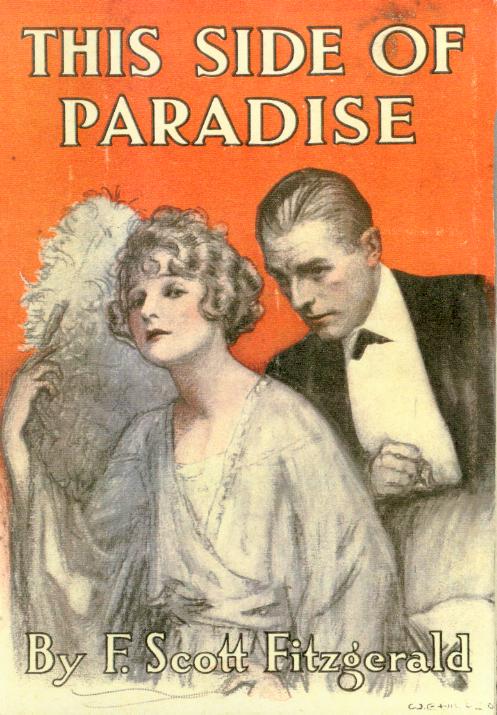
Review: "This Side of Paradise" by F. Scott Fitzgerald

Oh, boy, did I get in trouble with this one.

I was hanging out at the BF's apartment all this long weekend, and since he's deep in grad school hell, we spent most of the weekend with our books in our respective corners, ignoring each other. I read "The Book of Salt," "Slaughterhouse-Five," half of "The Hobbit," and today's book,  "This Side of Paradise" by F. Scott Fitzgerald (1920).

I blazed through it in a day and a half, tossed it to the side, and announced, "That was a stupid ending. All that happened was--" Except I didn't end my statement with two hyphens. I kept going. And the BF was pissed.

"I wanted to read that," he said quietly, turning away from me like an angry cat. "I haven't read it yet and I didn't want to know what happened."

Cardinal rule of responsible reading: don't give away the damn ending.

It was his book, too. I read his book and spoiled the ending for him. That's like showing up at someone's house, eating all their food, wiping your mouth on the cat, and bailing without even helping do the dishes. Or wash the cat.

How was the book itself? Prrreeettttyyy good, but not great. I can't deny that Fitzgerald has talent, and the fact that he wrote "This Side of Paradise" when he was but a tender lad of twenty-three is astounding. The book is about a young man named Amory Blaine, and tells of his birth and upbringing, his prep school days, his college days, and the few years follow college. We learn about his friends and lovers, the books he reads, and his search for himself.

Fitzgerald drew me into this story like Edith Wharton does. They both write so piercingly about the American upper-class, explaining hugely complex, labyrinthine social structures and morays with brevity and humor. I was fascinated by Fitzgerald's description of Princeton College life in the 1910s: the mad scramble for popularity and the inner social circle; the complete lack of regard for actual scholarship (boys who studied too hard were "grinds" and never popular or important); and the way these uber-privileged white men exercise their privilege and get ready to rule the country. There's also this really weird bit in the middle where Amory meets the devil--like, the actual Devil, Lord of Hell, First Among the Fallen, etc.--and then it's never mentioned again. Ever. You have to admire that kind of audacity.

However, you can tell that this book was written by a twenty-three-year-old. It's padded, pretentious, and attaches far too much importance to the types of feelings and events that for children are all-encompassing and catastophic, but for adults are merely the vagaries and bullshittiness of life that you learn to shrug off as you get older. I think there's a lot of value in an actual twenty-three-year-old writing about the emotional life of twenty-three-year-olds, because at least he's being honest, and this book is nothing but painfully honest. But Jesus, kid, so some girl dumped you for a richer man, you'll get over it (and hi, obvious inspiration for "The Great Gatsby," didn't expect to see you here!).

Also, there's a lot of bad teenage poetry in this book. Painfully bad teenage poetry, with rhymes and everything. I skipped over most of it, because the poetry doesn't advance the plot at all and is written in this leftover Victorian style that clearly hasn't felt the influence of Modernism yet. This makes it tonally at odds with the rest of the rather Modernist novel, in addition to being boring and irrelevant to the story.

Also also, casual racism, sprinkled here and there throughout, and on Big Island Rachel's Books, racism knocks you down at least one letter grade.

"This Side of Paradise" by F. Scott Fitzgerald: C.

Recommended for fans of the writer who are devouring his repertoire. All others should just re-read "The Great Gatsby."


Sunday, November 18, 2012

Review: "Rebecca" by Daphne du Maurier

Now we're cooking with gas.

"Rebecca" was published in 1938 to great critical and popular acclaim and it's considered a modern classic according to the tattered cover of the copy I found on someone's door stoop here in Brooklyn. That's right, this is a stoop find, and wow is it a good one! I didn't realize that it was written so recently. I only know it from clips of the Alfred Hitchcock movie (1940), and that footage led me to believe that "Rebecca" was a Gothic romance from the time of "Wuthering Heights."

The book is definitely a Gothic romance in plot and tone, but it's set in England in the 1930s, so while much of the setting is relatively modern--car travel and telephones are heavily featured--the characters themselves and their attitudes toward each other are holdovers from the Victorian era. There's a lot of interesting juxtaposition between the modern and the ancient in "Rebecca," embodied most strongly in the two mistresses of Manderley.

Rebecca de Winter was the first wife of Maxim de Winter, master of the famous estate and mansion Manderley. I think Maxim must be titled in some way because of the paternalistic way he talks about the people of the nearby town and countryside, and the way those peripheral characters talk about him, but you never learn what his exact title is. Rebecca herself probably has a title, too, because much is made of her good breeding and upbringing. Suffice to say that both Maxim and Rebecca are of the same landed gentry class.

The second Mrs. de Winter (and the narrator), whose first name we never learn, isn't landed gentry. At the beginning of the book, she's actually more of a maid, running errands for an obnoxious American in Monte Carlo. She meets and falls in love with Maxim there. Even though she's only known him for two weeks, and she's twenty years younger than him, AND they're at opposite ends of the social spectrum, she says yes to his marriage proposal and they bum around Italy for a while. Like ya do.

At this point, Rebecca has been dead for almost a year from a well-publicized boating accident, and the narrator is more than a little nervous about stepping into her role as mistress of the fabulous Manderley. Mrs. de Winter doesn't know how to command a staff of servants and she has no experience in socializing with people in the upper class, so she's already at a disadvantage. To make matters worse, Rebecca was apparently a joy and a pleasure to all who came across her, and everywhere she turns, the shy and diffident Mrs. de Winter finds herself compared to the glamorous Rebecca and coming up short. There are even some individuals lurking in the sidelines who miss Rebecca so terribly that they're actively plotting against Mrs. de Winter and her fledgling marriage to Maxim.

"Rebecca" isn't a ghost story in the traditional sense because there are no specters or ghouls, no doors blowing shut mysteriously or cold drafts from unexplained sources. Rebecca herself is most assuredly dead throughout the entire book. But she was such a mighty presence in life that Mrs. de Winter and Maxim feel haunted by her, by the memories that their servants and friends have of her, and by the house and grounds she decorated and designed. In a way, "Rebecca" is a more effective ghost story than one with an actual ghost in it because it is so realistic. It illustrates on how people live on after they die, in their physical possessions and in  hearts and minds of their social circle, and how difficult it is to bury the past when evidence of it is all around you.

But "Rebecca" is also a bit of a murder mystery, right down to the scene at the end where the detective gathers the players together in the library to go over the evidence and decide whodunit. But du Maurier turns this convention on its head as well, because we already know whodunit and why, and all of the characters do, too. It's a suspenseful scene where everyone is just waiting to see if the evidence will add up to the horrid truth or reinforce the comfortable lie.

"Rebecca" is a murder mystery without any mystery, and a ghost story without any ghost. It's a meditation on the encroachment of the modern world into the traditional one, and also questions just how wonderful "tradition" actually is. Does good breeding and a sparkling wit mean that one is a good person? Can someone still be good if they perform terrible deeds? What is the price of good appearances and a stiff upper lip?

"Rebecca" by Daphne du Maurier: A.

Recommended for anyone who likes a good ghost story, a Gothic romance, or the movie "Gosford Park." The movie isn't considered one of Hitchcock's best, though, so I'd avoid it unless you're really into Hitchcock.

Saturday, November 10, 2012

Review: "The Woman Reader" by Belinda Jack

In an unprecedented turn of events, it took me three weeks to finish this book. I'm a fast reader who likes to brag about reading at least two books a week, and I was humbled by Belinda Jack's "The Woman Reader." I don't know if it's because the book was non-fiction, dry, written at a graduate-school level, or some combination of the three, but it did not go down easy.

I would have given up on it all together if it wasn't for the subject matter.  I've been going around to my friends describing it as a history of women and literacy, but that's not entirely accurate. It's not about women writers, though they appear throughout the book; and it's not about rates of female literacy in various societies, though those statistics pop up. "The Woman Reader" is, quite literally, about women reading: what they read, how they read, and many extensive analyses of the moral panics and societal attitudes that surround the issue of women reading, from the nascent days of written language to the birth of electronic publishing.

This is the most difficult book I've read since college. If you had to look up the word "nascent," you might have the same complaints I have. It's full of history, dates, big words, and bigger ideas, and it's written in a very dry and straightforward style that doesn't flow that well to a reader like me, who rarely reads non-fiction and hasn't encountered academic writing in several years.

So why did I torture myself for three weeks slogging through this beast? Because "The Woman Reader" is an enormously rewarding and satisfying book, and not just because you get to remember all your SAT words. In a sea of pop-psychology and pseudo-sociology books  that purport to explain complex phenomena in a breezy finished-in-one-plane-ride format (looking at you, Caitlin Moran's "How to be a woman"), "The Woman Reader" tackles a huge subject with the gravity and depth it deserves and never wavers from its assumption of the reader's intelligence. This book knew just where to stroke me. I do so love to be recognized for my intellect.

The book follows a basic format: during this time period, in this society, we know that women were reading this or that, based on this documentation, and we know that the society reacted to their reading in this manner, based on this other documentation. Short answer: women read, and it bothers folks. Throughout Western history, a cloud of anxiety has surrounded the woman reader because her reading promotes an inner life and an inner reality that society can't touch or regulate. Therefore, society tries to restrict her reading to "appropriate" subject matter that reinforces the status quo.

And I hope you like British history, because that's what you're getting! Belinda Jack starts off in Mesopotamia, which is fine because it's the birthplace of writing, and then she touches briefly on the happenings before the rise of the Roman empire, which is also fine because not a lot of people were literate before then. But after that, she focuses almost exclusively on readers in Christian Europe, mentioning the literary accomplishments of the Muslim world only tangentially, and the literary traditions of Judaism and the Far East not at all. After the chapter on reading done in monasteries and nunneries in Europe, she focuses in even tighter on reading in England and stays there until the end of the book.

The Anglo-centric approach of "The Woman Reader" was often infuriating, especially when Jack rushes through Japanese or Chinese literature in a single page and devotes entire chapters to the differences between what British women were reading in the 1500s and what they were reading in the 1700s. I understand that Jack, being a British woman, has greater access to historical documents from her own country and a greater understanding of her own culture. But Japan produced the world's first novel, "The Tale of Genji" by Lady Murasaki Shikibu. There isn't exactly a dearth of analytical material on "The Tale of Genji" or the society and woman that produced it.

A more glaring oversight was Jack's lack of analysis of "The Peony Pavilion," a Chinese play written by Tang Xianzu. "The Peony Pavilion" is right in that sweet spot of women and reading that this book is about: controversial and censored since it's first performance in 1598, it's ignited societal fears about women's rebellion against authority for hundreds of years. And again, there's no lack of material about the play and it's history. 

Why the exclusion? Did "The Peony Pavilion" and "The Tale of Genji" represent too much of a departure from the neat linear history Jack was presenting with her focus on Britain? Did she feel she couldn't include an analysis of these works without an extensive exploration of the societies that produced them? Does she have later volumes of "The Woman Reader" planned that focus on non-Western women's reading? 

I guess what bothers me most about her Anglo-centrism is the same thing that bother me about "The Happiness Project": it's the implied universality of the subject matter. A book called "The Woman Reader" that ignores non-Western or even non-British women readers for a good chunk of its running time is basically saying that the normal woman reader is a Western Christian woman. I'm not going to lie: "The Woman Reader" is a bit racist.

As a reader more aware, if not more familiar, with non-Western traditions of literature in reading, this distracted me from my overall reading experience. Jack was giving me a lot of information, but she was also leaving a lot out. I hope she will do follow-up volumes to this one, because the subject matter is near and dear to me. I'm a reader. In terms of the way I see myself, the list goes 1) human being, 2) female, and 3) reader. I spend more time reading and more time thinking about the things I read than anything else. If I wasn't allowed to read--if I lived in a society that took my books away from me and limited my access to reading material--I sincerely believe I'd go insane. "The Woman Reader" is the first book I've ever read that put my experiences as a reader in a historical context, so I don't want to be too down on what she accomplished, which is a considerable feat of scholarly criticism and analysis.

Still--kinda racist. So final grade: C+.


Saturday, October 27, 2012

Regular service postponed

This is it, folks. It's the end of everything! The storm cometh, leaving a wide swath of destruction through the middle Atlantic states. Hurricane Sandy brings the wrath of God upon the hapless citizens of the coastline! Rain! Snow! Waves! Floods!
Birds! (Probably!)
Regular service on Big Island Rachel's media empire is postponed until we are no longer doomed.

Sunday, October 21, 2012

"Ceremony" by Leslie Marmon Silko

"Ceremony" by Leslie Marmon Silko is one of my three favorite books of all time. The other two are "The Book of Salt" by Monique Truong and "Paradise" by Toni Morrison.

Looking at this list, I discern a pattern: I like dense, modernist prose that plays around with time structure and explores intersecting themes of race, gender, class and sexuality. I also like 20th century American women writers of color. I took a whole class on them in college.

I first read "Ceremony" in that 20th century American women writers of color course (we never could come up with a shorter title). One of my biggest regrets of college was that I sold all of my books at the end of every semester and have had to re-purchase my favorites as a grown-up, like "Ceremony." I love this book. Every time I read it, I fall in love with it all over again: the language, the characters, the blending of myth and fact, the triumph of good over evil.

"Ceremony" is about a Laguna Indian named Tayo, a World War II veteran and survivor of the Bataan Death March who returns to his reservation a broken shell of a man. He's dealing with a complex tangle of emotions relating to his experiences both in the war, where he witnessed wholescale slaughter and the death of his brother; and in the American Indian communities within and around his reservation, where he sees his friends and neighbors give in to apathy and despair.

"Ceremony" illuminates an individual grappling with a state of mind that might be best described as "cultural trauma." According to the authors of "Cultural Trauma and Collective Identity," "cultural trauma occurs when members of a collectivity feel they have been subjected to a horrendous event that leaves indelible marks upon group consciousness, marking their memories forever and changing their identity in fundamental and irreversible ways." American Indians have endured a centuries-long physical, geographical, and political assault on their culture and way of life, and each individual in the community must face daily the repercussions of this assault. Tayo falls into despair and madness not just because of the war, but because the cultural framework which might have helped him heal has been systematically dismantled by historic oppression by the United States government. It's not an easy or comfortable topic to explore, but it is rewarding and necessary.

After a long stay in a mental hospital and a year or so of aimless drunken debauchery with the other veterans on the reservation, his family sends him to a medicine man in a last ditch effort to make him into a useful member of the tribe again. The medicine man and Tayo perform a ceremony. And here's where things get interesting. In the world of the Laguna Indians in this novel, "ceremony" refers not only to the traditional Scalp Ceremony that the medicine man and Tayo perform around a campfire one night; it also refers to Tayo's entire process of healing, which takes years, from the time he returns from the war to the very end of the novel. In this process, he discovers that his personal journey is simply part of a much larger ceremony that was set in motion generations before, which was begun in order to counter-act a massive, evil ceremony set in motion by witches at the dawn of time.

Furthermore, the book "Ceremony," the one I'm holding in my hand, is ITSELF part of this larger healing ceremony. The writing of "Ceremony" and the reading of "Ceremony" is part of the ceremony described in the book. Layers within layers, folks, that's what this book is about.

As I said, the book plays around with time structure. In Tayo's mind, all the events of his life and the life of the tribe are happening right now, so we jump around from his childhood days to his experiences in the war, from traditional Laguna folktales to the history of his own immediate family. It can be a bit of a challenge to follow, especially at the beginning of the book when we're still getting to know the character and his life, but everything necessary to know is mentioned or at least hinted at in the first 30 pages of the book, so if you can make it that far, you're golden.

When Tayo begins to heal and take an active part in the ceremony of his life, the time line of the book evens out and takes on a much more linear progression, which isn't always to its benefit. I actually start to get bored when Tayo hunts the spotted cattle on Mount Taylor. It's the longest the book has followed a single storyline happening at a single point in time up until now, and it feels a little dragged-out. I understand why it's written that way. Tayo's mental state is very clear when he is performing this part of the ceremony, much less muddled with memories and pain, so we get a very clear idea of what's happening at this important part of his life. But it just--keeps--going. It's a chunk of the book that I feel I have to slog through to get to the good stuff on the other side. Fortunately, the ending of the book is really dark and twisted, though still happy in a way, so I can read through the hunt knowing I've got something good waiting for me on the other side.

Final Grade: A.


Saturday, October 20, 2012

"The Happiness Project" by Gretchen Rubin

I don't normally read non-fiction outside of my comic books.
This happened. And then they hushed it up!
But I was in LAX after my sister's wedding, killing time before my LA to New York City flight by browsing the airport bookstore because all bookstores are a siren call to me even if they're showcasing "Girl with the Dragon Tattoo" and "50 Shades of Gray" (Grey? I have too much personal integrity to look it up). Airport bookstores always stock books of the zeitguiest, so I was unexpectedly exposed to a whole new set of reading material I would never seek out for myself. "The Happiness Project," by Gretchen Rubin, was one of those books. Since it was my inspiration for re-starting this blog, it feels fitting to dedicate my re-inaugeral post of Big Island Rachel's Books to a review of "The Happiness Project."

Did I like it? Yes. Am I incorporating some of it's material into my life? Absolutely. But was it perfect? Of course not. I had some major problems with the way the author presented her project, and it will surprise no one that the things I found most problematic were--wait for it--gender roles.

So "The Happiness Project" is one person's attempt to optimize her happiness. I like this sort of thing. It's lifehacking, shortcuts to making things easy for yourself, and as I said, I found a lot of stuff in the book useful. Rubin did tones of research into what happiness is and what makes people happy from a scientific standpoint. This wasn't a touchy-feely spiritual book (though there was a chapter on spirituality), it was a fact-based attempt to be the happiest person the author could be in the circumstances she was currently in.

Some things I took away: if you ACT happy, you will FEEL happy. No more walking around with slumped shoulders and a sour look on my face, no more "I'm too tired" to smile at my customers. Do things you're passionate about. You get more energy from doing something you love than you do from sitting around doing nothing, even though you think the sitting-around time is what's going to energize you because hey, what's more energizing than resting? On a related note, there's more happiness in "project happiness" than there is in "instant happiness." Hence the increase in my blogging and the decrease in my cartoon watching. I'm going to get more happiness from updating my regular blog, my books blog, and my Tumblr--and of course the radio show--than I am from re-watching "Sherlock" (which I'm actually doing while I type this, because shut up, it's a good show).

So those are the things I liked about the book: practical advice for optimizing your happiness with the life you have right now.

Here's what I didn't like, and like I said, it has to do with gender roles, so I'm about to off on one of my famous feminist rants. You've been warned.

Rubin says at the beginning of her book that fifty percent of a person's happiness is genetic and can't be altered. Twenty to thirty percent of happiness is based on things that can't be altered, like birthplace, age, and gender. Her project was focused on the ten to twenty percent of happiness that a person can directly affect. Which is all well and good, but back up a second--gender? Are there measurable differences in a person's happiness depending on whether they are male or female? To me, that's very interesting, but Rubin never brings it up again, even when she clearly needs to.

At the time she wrote the book, Rubin was a professional writer working from home. She had a seven-year-old and a two-year-old, and was happily married to her husband. There was a whole chapter on how she tried to be happier in her marriage, which in my mind was the perfect time to bring up the issue of happiness varying between genders. She states at the onset that she tends to nag her husband and get resentful of the fact that she does more housework and childcare than he does without getting the praise she wants for it. Her solution was to stop nagging, do what had to be done herself without waiting for her husband to do it, and stop expecting praise.

Excuse me while I bang my forehead against the keyboard. \g9i u09349qutqn 39804uoeiuar9082%. There, I'm done. I'll give Rubin credit for saying in her wrap-up chapter that she was afraid this approach would lead to her husband doing even less household word, and I'll give her husband credit for actually doing the opposite and stepping up his game when Rubin changed her approach. But there is something HUGELY problematic about a woman asking herself how she can be happier and determining  that more housework and less recognition for it are the answers.

Happiness is a complicated issue for women. We don't have the same cultural space that men do to be unhappy and angry. Women are trained to please and we're expected to be happy all the time, whereas men are allowed to have their teenage angst and their quarter- and mid-life crises. If Rubin found happiness in re-establishing traditional gender roles in her marriage by just shutting up and doing more housework, more power to her, especially if she got the end result she wanted, which was for her husband to pitch in without her nagging him. But there wasn't a single sentence in this book devoted to exploring the complex relationship between gender and happiness, and considering that one of her chapters is about marriage and another is about her children, it should have come up.

The lack of discussion around the issue made me furious a couple of times. Rubin relates a difficult Saturday when her kids aren't getting along, and she snaps at her husband because he spent time at the gym and then took a nap, leaving her to deal with the fighting, crying kids all day while he had leisure time alone. After she snaps at him, she feels bad because one of her happiness resolutions was to stop saying mean things to her husband. And damned if I didn't want to throw the book across the room, not because I disagreed with her handling of the situation--it was her happiness project, not mine, and I'm neither married nor a mother, so what do I know?--but because she didn't take the opportunity presented by that story to bring up any number of studies done on how many more hours a week women spend than men on housework and child-rearing, and how that affects the happiness of women and the stability of marriages. In a word: problematic.

Sometimes I wonder if people get tired of me pointing out sexist shit. And then I wonder why people don't get tired of all that sexist shit instead. Because I sure do. I'd love to wake up tomorrow to a world where I don't have to point out that it's problematic to write a book on happiness and not explore gender roles. Until that happens, I guess I'll just have to keep pointing it out.

Final grade: solid B. Good writing, well researched, but not feminist enough for me.

Tuesday, April 26, 2011

"Just Kids," Patti Smith


To my shame, I don't know a lot of Patti Smith's work. But she performed at a ceremony held by my company two years ago, when she received some kind of honor or degree from us, I'm not clear on the details, and by all accounts, she rocks. Her memoir, "Just Kids," won the National Book Award in 2010, and since I like reading about New York City and she has a connection to my job, I put the book on my library request list and waited. Patiently. For four months.

Being broke sucks.

The book is an account of Patti Smith's early years in New York City, from 1968 to about 1975, specifically her development as an artist and her friendship with Robert Mapplethorpe. Mapplethorpe is famous for taking pictures that cause Midwesterners to protest outside of museums--bloodied male genitals, riding crops stuck up asses, that sort of thing. I'm not going to post any of his work here because I don't want to get fired, but you can Google him if you're in a secluded area.

The book is a slow burn compared to most memoirs I've read. What keeps it going aren't deep dark secrets and soap opera revelations--just an aside, the memoir most guilty of this is "The Kiss," which is a memoir about a woman who had a sexual relationship with her father--but rather a series of quiet, thorough, and penetrating examination of the question, "From whence comes the artist?" It's a story that focuses on the artistic processes of Smith and Mapplethorpe, on how they developed as artists and as people.

I wouldn't recommend this book to people who like cinematic literature. The book isn't plot-driven, and it definitely feels like the author is looking back on a time long past, so there really isn't much of a sense of urgency in her writing, which is compounded by the fact that she uses very simple, straightforward language. Once you get into her rhythm, though, it's amazing how her simple prose can hit you right in the solar plexus. Alone, phrases like, "We were still intimate," or "Robert was asleep on the couch and Fred was crying," don't have much impact, but when read as part of the whole, they're heartbreaking.

Not a lot of people write like this anymore. There's something very Left Bank/Lost Generation about "Just Kids," with it's simplicity and search for meaning beyond the lense of nostalgia. Recommended for people who know a little about the art scene in New York City of the late 60s and early 70s, and of course, rock aficionados.